I’ve worked in the NICU for eleven years, and I’ve learned that life often arrives fighting.
But nothing prepared me for the night that baby came in.
She was barely twenty-seven weeks. Blue. Limp. Her cry—if you could call it that—was a thin rasp swallowed by the oxygen mask as the transport team rushed her through the double doors.
“Premature female, respiratory distress, unstable vitals,” someone called out.
I moved automatically. Warm towels. Intubation tray. Ventilator ready.
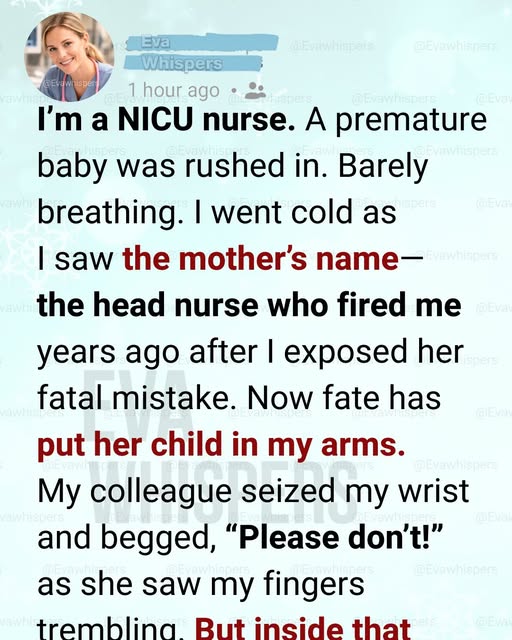
And then I saw the mother’s name on the admission chart.

Claire Donovan.
My hands went cold.
Claire Donovan had once been my head nurse. Five years ago, I had reported a medication dosage error she made—an error that contributed to a newborn’s death. I hadn’t done it out of spite. I had done it because the chart didn’t add up and the baby deserved the truth.
The investigation that followed was ugly. Meetings behind closed doors. Accusations that I was “misreading data.” Whispers that I was trying to climb the ladder by stepping on others. In the end, Claire kept her title. I lost my job.
My career nearly collapsed before another hospital took a chance on me.
And now fate had placed her child in my hands.
Inside the incubator, the baby’s oxygen saturation plummeted.
“Eighty-two… seventy-nine…” my colleague Marisol read off the monitor.
The alarms chimed sharply.
For a split second, something ugly flared in my chest. A memory of humiliation. Of standing alone in a conference room while my integrity was questioned.
Marisol grabbed my wrist. “Don’t freeze,” she whispered urgently. “We need steady hands.”
She thought I was panicking.
In truth, I was choosing.
I forced my breathing to slow. The infant’s skin was translucent, her ribs visible with every fragile attempt to inhale.
This child had nothing to do with the past.
I adjusted the ventilator settings, fine-tuning the pressure to ease her lungs open without causing damage. I repositioned her tiny body, ensuring her airway remained aligned. I recalculated the surfactant dosage down to the decimal point, double-checking every unit before administering it.
“Okay, sweetheart,” I murmured through the plastic walls of the incubator. “We’ve got you.”

Her oxygen levels climbed back into the nineties.
Crisis stabilized.
Hours passed. My shift technically ended at 7 p.m., but I didn’t leave. I charted every fluctuation. I monitored every lab result the moment it posted. When her blood gases shifted even slightly off trend, I was already adjusting.
Over the next few days, her condition seesawed the way premature infants often do. A small brain bleed threatened. A feeding intolerance worried the neonatologist. There were whispers about transferring her if she didn’t gain weight.
I pushed back.
“She’s stabilizing,” I argued in rounds. “Her lung compliance is improving. Let’s give her another forty-eight hours.”
I caught an early infection marker before it became septic. I advocated for a pediatric cardiology consult when her murmur sounded subtly different. I celebrated every ten grams she gained as if it were a marathon.
Through it all, I saw Claire only from a distance.
She looked smaller than I remembered. No sharp authority in her posture now—just a mother gripping the incubator rail, eyes red from crying. She asked careful questions. She thanked every nurse.
She never looked at me long enough to recognize me.
Weeks passed.
The day came when we trialed the baby off ventilator support. I stood beside the incubator as we reduced the settings.
Her chest fluttered. Paused.
Then, slowly, she inhaled on her own.
One breath.
Then another.
The room held its silence like something sacred.
Her oxygen saturation stayed steady.
“She’s breathing independently,” the neonatologist confirmed softly.

Claire broke down. A raw, shaking sob tore out of her. She hugged the respiratory therapist, then Marisol, then me.
“Thank you,” she cried against my shoulder. “Thank you for saving her.”
I held her gently.
“You’re welcome,” I said.
She pulled back, eyes full of gratitude and exhaustion. She had no idea who I was. No idea that years ago, she had signed paperwork that nearly ended my career.
For a fleeting moment, I wondered if I should tell her.
But what would that change?
This wasn’t about settling scores.
It was about a little girl who would someday run across playgrounds, argue with her parents, maybe roll her eyes at curfews. A life untouched by boardroom politics and adult failures.
The baby continued to grow stronger. Feeding tubes came out. Weight climbed steadily. The monitors that once screamed now hummed softly in the background.
The night she was transferred out of the NICU, I finished my charting long after most of the lights had dimmed.
As I walked down the quiet hallway, exhaustion settled into my bones—but so did something steadier.
Five years ago, my pride had shattered in a hospital corridor not unlike this one. I had questioned whether integrity was worth the cost
Now I knew.
My integrity had survived the very place where it once broke.
Not because I won. Not because I was vindicated.
But because when it mattered most—when no one was watching, when resentment would have been easy—I chose the baby.
And that was enough.
Note: This story is a work of fiction inspired by real events. Names, characters, and details have been altered. Any resemblance is coincidental. The author and publisher disclaim accuracy, liability, and responsibility for interpretations or reliance. All images are for illustration purposes only.